

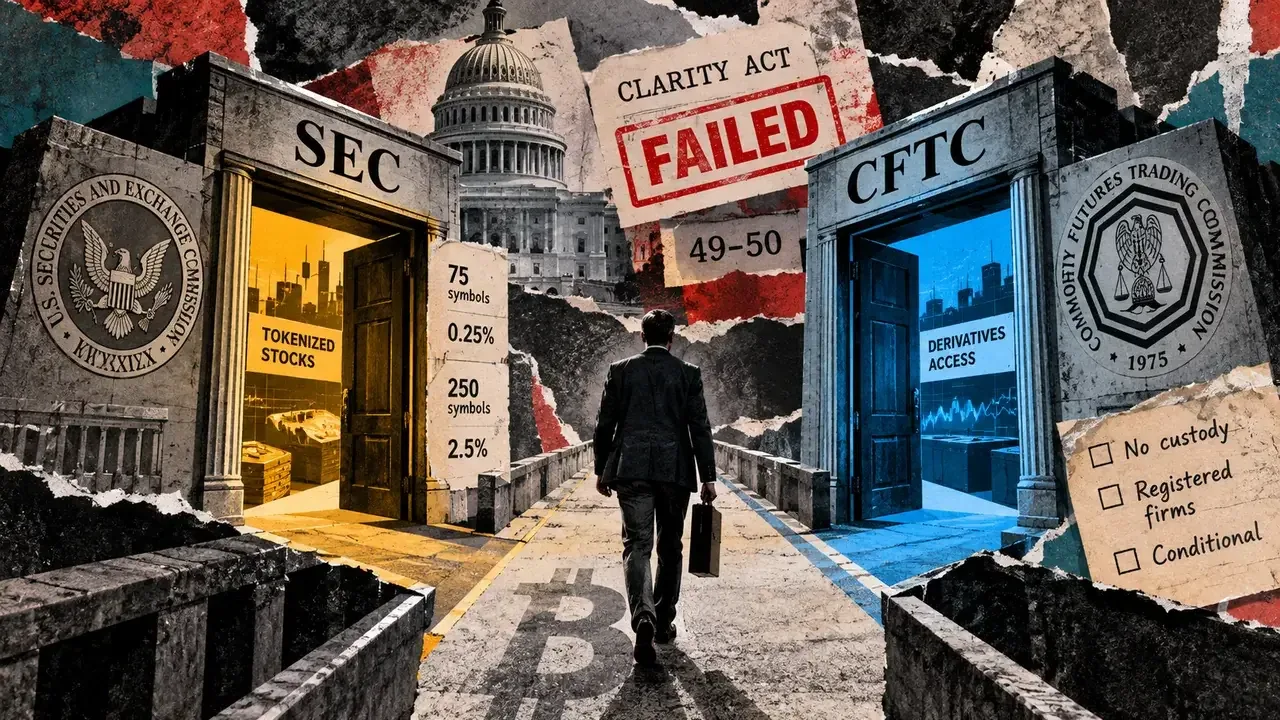
Regulators Act Where Congress Stalled
Two days after the U.S. Senate failed to invoke cloture on the CLARITY Act — a 49-50 procedural vote that effectively shelved the most comprehensive crypto market-structure bill in years — the Securities and Exchange Commission and the Commodity Futures Trading Commission moved in tandem to open constrained pathways for crypto-linked market activity under existing statutory authority. The coordinated action signals a pragmatic shift: rather than wait for legislative clarity, regulators are carving out experimental sandboxes with hard guardrails.
SEC's Innovation Exemption: A Five-Year Tokenized Equity Pilot
On September 17, SEC Chairman Paul Atkins unveiled the Innovation Exemption, creating a new category called a Tokenized Securities Venue (TSV). The order permits qualifying venues to match buyers and sellers through permissioned automated market maker (AMM) liquidity pools without registering as national securities exchanges. Key constraints define the experiment's scope:
- Volume and symbol caps: Tier 1 stocks limited to 75 symbols and 0.25% of average daily volume; Tier 2 stocks capped at 250 symbols and 2.5% of volume.
- Issuer veto power: Before a TSV lists a tokenized stock from an unaffiliated third party, the issuer must be notified and has a 30-day window to object — an objection blocks listing on that venue.
- Permissioned access on public chains: While underlying blockchains may be permissionless, TSVs must verify participants, set access standards, and disclose denial criteria. Smart contracts must be public and auditable.
- Sunset clause: The exemption expires September 17, 2031, unless modified — a deliberate five-year test window.
The order preserves Securities Act requirements, antifraud rules, sanctions compliance, and AML obligations. It replaces full exchange oversight with tailored conditions rather than removing market safeguards.
CFTC's Letter 26-25: Software Providers as Regulated Interfaces
Same day, the CFTC's Market Participants Division issued Letter 26-25, generalizing no-action relief previously granted only to Phantom (Letter 26-09). The relief allows qualifying passive software providers — not limited to crypto wallets — to display market data, solicit users, receive revenue-sharing fees, and transmit user-directed orders to registered derivatives firms without registering as introducing brokers or associated persons for those covered activities.
Critical limitations preserve the registered-firm backbone:
- Providers cannot hold customer assets, generate express buy/sell signals, or exercise discretion over order routing or execution.
- Users must onboard directly with a designated contract market, futures commission merchant, or introducing broker — independently of the software provider.
- Funds securing positions remain with a derivatives clearing organization and/or clearing-member FCM.
- The relief addresses only introducing-broker/associated-person registration; all other registration categories and laws remain fully applicable.
Market Impact Analysis: Measured Progress, Not Breakthrough
The dual announcements represent regulatory improvisation, not structural reform. For market participants, the implications are nuanced:
- Tokenized equities: The TSV framework legitimizes on-chain equity settlement for a narrow slice of the U.S. market, but volume caps and issuer vetoes ensure it remains a pilot — not a parallel market. Custodians, transfer agents, and broker-dealers still control the on/off ramps.
- DeFi derivatives access: Letter 26-25 blesses the "front-end" model where wallets and dashboards route orders to regulated venues. This could accelerate institutional DeFi adoption by reducing legal uncertainty for interface providers — but the registered-firm requirement means true disintermediation remains off the table.
- Legislative pressure: By acting within existing authority, regulators may have reduced urgency for Congress to pass comprehensive market-structure legislation. The CLARITY Act's failure now carries less immediate consequence, potentially prolonging legislative gridlock.
Outlook: Sandboxes as Substitute for Statutes
Both frameworks share a common architecture: time-limited, volume-capped, permissioned experiments that preserve the existing regulatory perimeter while allowing controlled innovation. The SEC's five-year sunset and the CFTC's staff-level no-action letter (revocable at any time) underscore their provisional nature.
For builders, the message is clear: regulated crypto market access is arriving in increments, not waves. The path forward runs through registered intermediaries, issuer consent, and explicit regulatory tolerance — not permissionless disruption. Until Congress acts, these sandboxes are the only game in town.
Market context
Market data reflects conditions at publication time and is not updated in real time.
Data captured at: Sep 18, 2026 16:34 (Tehran)
Likely market impact
| Segment | Outlook |
|---|---|
| Bitcoin | ● Neutral |
| Ethereum | ● Neutral |
| Altcoins | ▲ Positive |
| Short term | ● Neutral |
| Long term | ▲ Positive |
Spot prices at publication
Fear & Greed Index
Chart
Source: CryptoSlate